

| Seminar Date: | Tuesday, May 21, 2013 |
| Time: | 12:30 PM - 1:30 PM |
| Location: | Madrone |
| Abstract: | Since the discovery of the neutrino oscillations in 1998, the experimental program to precisely determine the details of how neutrinos change flavor has generally used heavy nuclei as the medium for detection. Among other things, this choice affords increased interaction statistics to more quickly gain sensitivity to the oscillation parameters, and has allowed for a first look at GeV-range neutrino and anti-neutrino cross sections on heavy nuclei. The dominant interaction for this energy region is the charged current quasi-elastic channel (CCQE, nu_l + N -> l^+- + N'), and in the last decade multiple experiments have seen hints that our description of nuclear physics is insufficient to describe neutrino scattering in a nuclear environment. I'll describe MiniBooNE's contribution to this puzzle and present the first measurement of anti-neutrino CCQE cross sections below 1 GeV. Along the way, I'll present a novel and crucial measurement of the muon neutrino component of MiniBooNE's anti-neutrino mode beam using statistical techniques. |
| Speaker: | Joe Grange - University of Florida
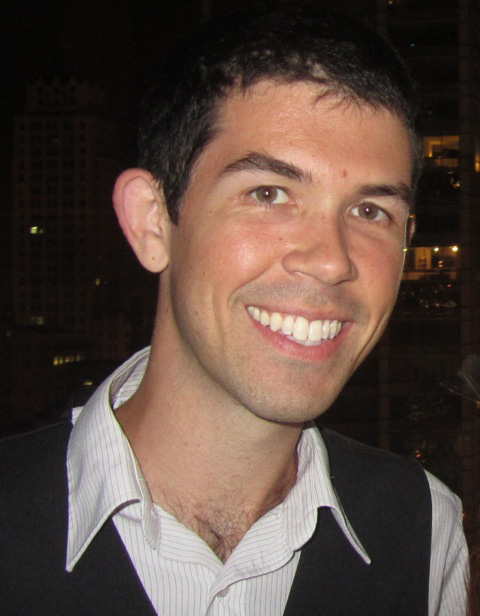 Joseph Grange grew up in Portland, Oregon and studied physics as an undergraduate at the University of Puget Sound in Tacoma, WA. After a brief immersion in the science of candy making, he returned to physics with the University of Florida. He recently received his doctorate there for his studies of neutrino interactions, and will soon transition to work on the new g-2 project with Argonne National Lab.
|