TESTING AND DEVELOPMENT OF THE RADIAL 3.1 AND RECTILINEAR 5.0 DESIGN PROTOTYPES
|
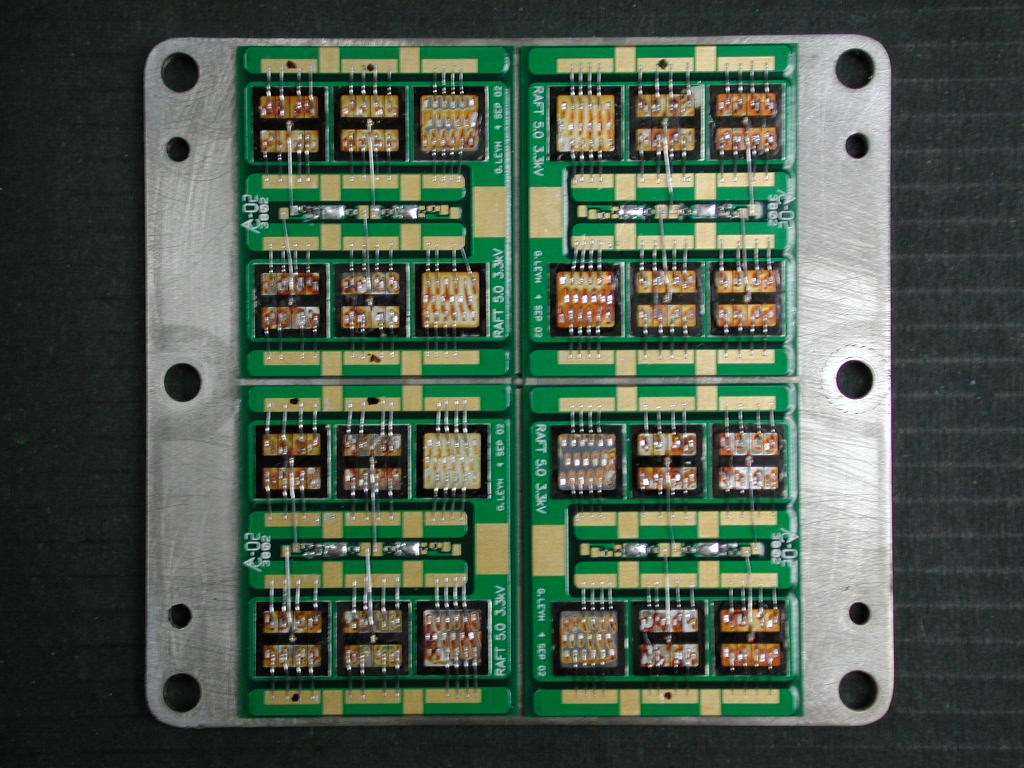
This is the first example of the Rectilinear 5.0 prototype, ready for testing. The four raft substrates are made of FR4, using a standard PC board fab process. The conductors are 10 micron gold flash over 80 micron nickel, over 3oz copper. The nickel provides an 'anvil' for the bonding wires during the ultrasonic bonding process. The substrates are mounted to an backing plate made of an Aluminum Silicon Carbide matrix.
The dies for this initial round of tests were 'reclaimed' from the number of failed IGBTs that we had on hand, as virgin dies were not available on a convenient time frame. As might be expected, the die salvaging process damaged many of the dies, and even after carefully testing the survivors, the final mounting process damaged still more. The overall yield rate for the die salvage effort was about 20%
Shown below is a mapping of voltage distributions made on the assembled prototype under high dI/dt conditions. Large 'X's indicate the positions with failed dies. These measurements were taken at 500 volts, which was the lowest possible voltage that could provide a comparable dI/dt. The drive voltage was kept as low as possible to minimize stress on the fragile reclaimed dies.
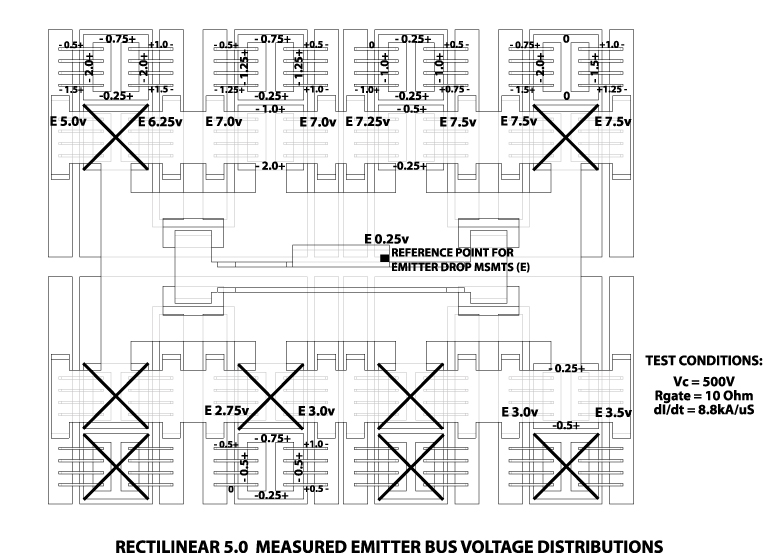 |
On the upper row of dies one can see that there is a nominal horizontal gradient, and a significant vertical voltage gradient across each die. This appears to be caused by the voltage drop down the copper conductors to either side of the die. This will be remedied in the next build by tightly clustering the wire bonding points where they attach to the copper. Voltage drops on each of the four corner wires show that currents exiting the die vary roughly by about a factor of three.
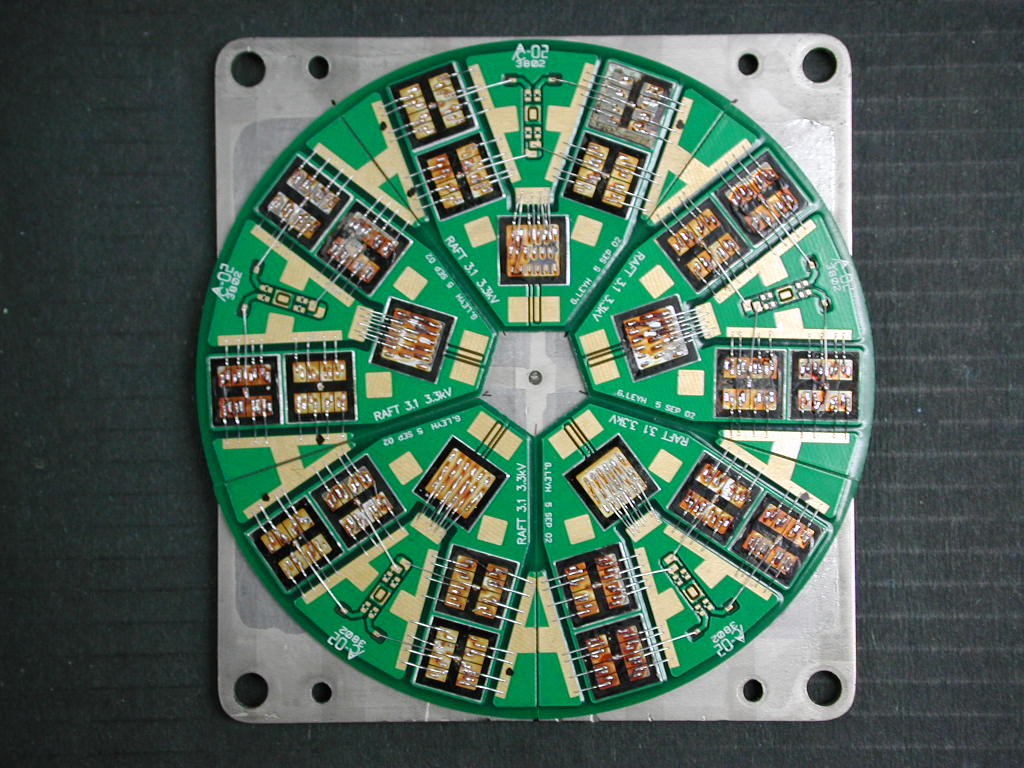 |
This is the first example of the Radial 3.1 prototype using
reclaimed dies, ready for testing. Black dots indicate the location of
failed dies. The raft construction is similiar to the Rectilinear design
above, but with 5 radially configured rafts. The substrates are also
mounted to an backing plate made of an Aluminum Silicon Carbide matrix.
As of a few days ago, we have received 110 virgin IGBT dies, direct from the foundry in Europe. At present, these dies are being assembled onto new substrates by Mfr 'C', with the clustered bonding wire geometry as discussed above. Full prototypes with the new dies should be available for testing by 17 DEC 02. Considerably more comprehensive testing is planned with these virgin dies, at higher voltage and power levels.
More details will be added to this page as they develop.