

Recent Results
Posted on Feb 17, 2010
Undulators installed for Echo-7
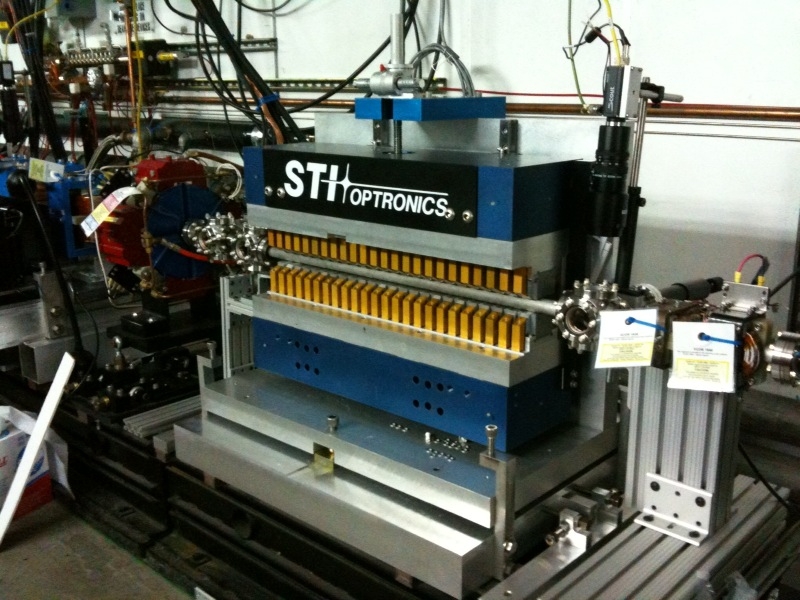
Two Undulators have been installed this week at NLCTA, completing the beam line for Echo-7. After this week’s installation and controls outage we will proceed with our beam operation next week. Stay tuned for exciting news over the next weeks.
Posted on Jan 18, 2010
ATF2 restarts operations
ATF2 restarts beam operations this week with a goal of establishing "nominal" optics. Before now, ATF2 has been operating with an optics configuration providing a larger than design beam at the interaction point (IP) (~1-3um) to make commissioning of hardware easier. With the IP beam size monitor ("Shintake Monitor") now commissioned, the ATF2 commissioning team now starts the difficult job of learning how to tune and measure the vertical beam spot at the IP below the 1um scale down to the goal of ~35nm. The operations schedule can be viewed from the ATF website http://atf.kek.jp/collab/ap/operation/index.php
Posted on Jan 17, 2010
S1-Global project
FNAL recently sent two superconducting cavities to KEK for the 'S1-Global' project that have power couplers which were assembled, cleaned, baked and rf processed at SLAC. The cavities performed as well in 'horizontal' tests, where the couplers are used, as they did in 'vertical' tests, where they are not used. This is a testament to the care taken in assembling the couplers in the class 10 cleanroom in Building 6 at SLAC where particle counters are used to verify the cleanliness of the parts. Particle contamination in either the coupler or cavity can reduce the gradient that the cavity can sustain.
Posted on Jan 16, 2010
Early Career Research Program
Congratulations, Yuantao Ding!
His "Generation and Characterization of Ultra-short electron beams for xray free electron lasers," submitted in response to the DOE Office of Science Early Career Research Program (Funding Opportunity Announcement DE-PS02-09ER09-26 or DOE National Laboratory Announcement LAB 09-26), has been selected for an award.
Information regarding that announcement, including the DOE press release, can be found on the main DOE website: http://www.energy.gov/
Posted on Jan 15, 2010
LCLS result
On Dec 18, the LCLS operated at record photon energy of 10 KeV, with 500 micro joules (3x10^11 photons) per pulse. This was achieved with sufficient spare klystrons in the L2 and L3 linac regions to provide a reasonable operating point for user experiments. The increase from the normal 8.3 KeV hard X-ray operating point was obtained by changing the energy in the second bunch compressor from 4.3 to 5.3 GeV, and activating all available stations in L3 on beam. Changing energy and lasing took about an hour, with an additional hour spent tuning for increased power.
Posted on Jan 12, 2010
Jeff Smith Helps Keep the LHC Beam in Check
Here at SLAC, Jeff Smith studies collimation systems, which he describes as machine protection structures for the Large Hadron Collider. While designing a collimator may not sound as flashy as colliding proton beams, it is a necessary precaution to protect nearby equipment from the collider's high-energy beams... » more
Posted on Dec 14, 2009
Funding Approved for Test Beams in ESA
Late last week DOE funded the first stage for future test beams in End Station A (ESA). This will allow us to build four new kicker magnets for the Beam Switch Yard (BSY) and to modernize the personnel protection system (PPS) of ESA. Late in 2010 we hope to kick a few Hz of the 14.6 GeV LCLS beam into the A-line and conduct again detector development and LC beam-detector interface studies in ESA. In a second stage a hadron target could be added at the end of the A-line which would allow additional detector studies with pions and kaons.
Posted on Dec 09, 2009
Siemann Graduate Fellowship
Chris McGuinness, working in the Advanced Acceleration Department, has been nominated as the first Siemann Graduate Fellow! The Siemann Fellowship was established by Hanna Siemann to support outstanding physics PhD students who are conducting research at SLAC or in the fields of high energy, particle, or accelerator physics. A gifted and visionary scientist, Robert Siemann was committed to educating young physics students throughout his lifetime. With graduate fellowships endowed in his honor, Stanford students will continue to benefit from his legacy forever.
http://www.stanford.edu/dept/humsci/external/documents/Siemann_spotlight1.pdf
Posted on Nov 16, 2009
ATF2: Beam Size Monitor
On November 13, 2009 the team working at ATF2 at KEK has achieved an important milestone: first measurement of the vertical beam size by the Beam Size Monitor working in the laser interferometer mode, as reported by Takashi Yamanaka representing the BSM group. The beamsize measured was 3.3 microns, consistent with the large beta function optics presently used. SLAC team presently at KEK made significant contribution to tuning of the beam before and during the measurements. This milestone is very important achievement on the way towards the ATF2 goal.
Posted on Oct 29, 2009
Anti e-Cloud Coatings "AEC'09"
"AEC'09"
October 12 - 13, 2009 at CERN
Mauro Pivi/Uli Wienands
The topic of the workshop was on anti electron-cloud coatings that do not require activation. Workshop topics will include : motivation and requirements on coatings (secondary emission yields etc), future plans, production and characterization of coatings, vacuum and impedance properties, beam measurements with & w/o coatings. In particular, the focus was on possible remedies for the electron cloud in the CERN SPS injector of LHC. An electron cloud in the SPS may seriously limit the luminosity performances of the LHC.
A tremendous progress has been achieved lately in the field of electron cloud mitigations. Reports from various laboratory on TiN coating showed mixed results. Experiences at PEP-II SLAC and KEKB show that TiN coating is a viable choice to mitigate electron cloud in positron machines, while reports from proton machines, as the spallation neutron sources SNS at OakRidge and PSR at Los Alamos, show that TiN not always reduces the electron cloud as expected.
Amorphous carbon is a promising novel coating that has a stable secondary emission yield below unity as measured at CERN. For this reason, coating of a large fraction of the CERN SPS with amorphous carbon is under consideration for the next machine upgrade phase. In CesrTA at Cornell University, amorphous carbon have been tested with very promising results and monitoring is underway to estimate its impact on dynamic vacuum.
Metallic and dielectric microparticles coatings showed an extreme reduction of the SEY well below unity at studies performed at ICMM Madrid. Besides coating, other techniques as grooves and clearing electrodes have shown a reduction of order of magnitude in the electron cloud effect in experimental tests in particle accelerators and are now a consolidated choice for future machines as the Damping Rings of future Linear Colliders ILC and CLIC or the SuperB factories.
Posted on Oct 28, 2009
First Echo installation
First Echo-7 Installation Successfully Completed.
Posted on Oct 21, 2009
Phase shift test
We successfully tested a new SLAC-designed remote-controllable L-band (1.3 GHz) phase shifter at high power. This phase shifter will be used as part of an rf distribution system that is being built at SLAC for a superconducting rf linac string test at FNAL.
Posted on Sep 23, 2009
CLIC Polarized Source Demonstration
The ARD LC Sources Group has successfully extracted more than 1013 polarized electrons in a 156 ns wide pulse. A separate measurement showed the polarization to be more than 85%. This work was accomplished in the Building 006 Gun Test Facility using the SLC gun, a GaAs/GaAsP strained superlattice cathode, and the FlashTi laser which has been modified to produce shortened, high peak power optical pulses. The activity is a demonstration of a laser, cathode, and gun which together exceed the 0.5 TeV CLIC source requirements by a factor of 3 and the 3 TeV CLIC requirements by a factor of 5.
Posted on Sep 10, 2009
FACET CD-1 Approval
The ESAAB was conducted today and Dennis Kovar approved CD-1 for the FACET project.
Posted on Sep 2, 2009
Mandrel, Cooling Coil and Support shaft for Rotatable Collimator brazed
On August 28 the Klystron shop successfully brazed together the molybdenum shaft assembly (see the May 18 "Recent Result" item) and a 45 foot long 10mm x 10mm copper cooling coil to a grooved copper mandrel. The grooves were cut extra deep so that a final machining pass could create a smooth surface matched to the inner diameter of the planned Glipcop collimator jaw annuli. Brazing the copper plated Glidcop jaws to the mandrel assembly is the next step in the process of creating a rotatable collimator for the LHC. See the closeup photo of the assembly on its stand after brazing. The spiral features visible are the cooling coil grooves and a vacuum pumpout groove. A second photo shows the entire ~1m long assembly.
Posted on Aug 11, 2009
Phase II SBIR award
The Advanced Computations won a Phase II SBIR award with Kitware Inc. on "Collaborative Visualization for Large-Scale Accelerator Electromagnetic Modeling", which will develop visualization tools for scientists at different geographical loactions to facilitate scientific collaboration.
Posted on July 15, 2009
Symposium and ICFA workshop
ARD hosted the a Symposium in Memory of Bob Siemann and an ICFA Mini-Workshop on Novel Concepts for Linear Accelerators and Colliders. Both of these were a great success in a large part due to the effort by Eric Colby, Naomi Nagahashi and Joan Valine... » more
Posted on July 1, 2009
Advanced simulation and computational science research under SciDAC helped solve the BBU problem at CEBAF.
At Jefferson Lab, scientists use CEBAF (Continuous Electron Beam Accelerator Facility) and three experimental halls to study quarks, gluons, protons and neutrons inside the nucleus with CEBAF and its three experimental halls. ...
» more
Posted on July 1, 2009
24 Hour L-band Station Operation
The new L-band (1.3 GHz) rf station at ESB started 24 hour operation. The station consists of a SLAC-built, 120 kV, Marx-style modulator that powers a Toshiba Multi-beam klystron to produce 10 MW, 1.6 ms long rf pulses at 4 Hz. This modulator/klystron pair is a prototype rf source for the ILC linacs, and will be operated for up to a year to evaluate the reliability of the components, including a new VME-based EPICs control system.
Posted on Jun 16, 2009
Marx and S-Band Klystron in ESB are happily running together.
Yesterday, a team of physicists and engineers from SLAC National Accelerator Laboratory completed initial testing on a new power source, the Marx modulator, connected to its target device, and launched a yearlong test. This test will be the final step in proving the reliability of a device poised to transform the way particle accelerators are powered ... » more
Posted on May 21, 2009
Support shaft for Rotatable Collimator brazed
On May 18 another new support shaft for the rotatable collimator was successfully brazed by the Klystron shop. The design uses hollow molybdenum half shafts machined with strong but flexible fingers that are brazed to either side of a central copper plated Glidcop "hub". After final machining straightness and concentricity will be better than 0.001". See the photo of the assembly just prior to the braze.
Posted on Feb 25, 2009
NLCTA Staion 1 Back Online
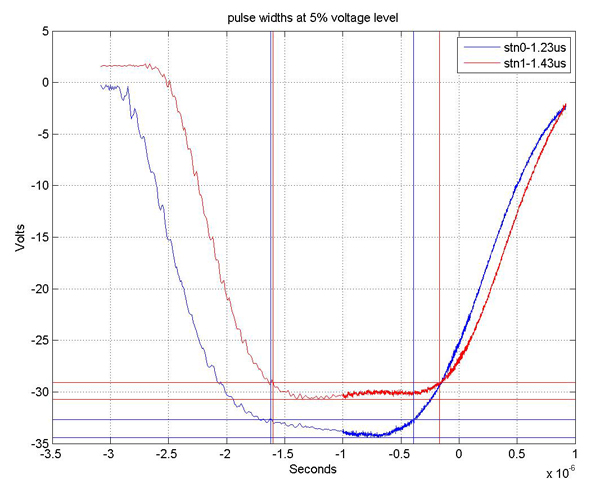
At NLCTA this past week X-Band RF Station 1 was turned back on after a new structure was installed and maintenance & repair had been done on the modulator. Members of PCD found that the modulator had one bad thyratron and one good thyratron. After removing the bad one (only need one in our current configuration), they turned station 1 back on. Unfortunately it's modulator voltage pulse was very narrow, about 200ns wide flat top. PCD's John Krzaszczak came back the next day after running some simulations on how best to tune the pulse forming network (PFN). After a few iterations of turning the modulator off, tweaking the PFN, and turning the modulator back on, John reported that the pulse shape was much improved. A scope trace was saved and analyzed, see attached figure. Defining the flat top as voltage within 5% of the minimum, the width of station 1's pulse was calculated to be 1.4 us. The widest we've seen in the past few months has been about 1 us. The figure also shows Station 0's waveform with a 5% flat top of 1.2 us. Faya Wang is now starting the program to process the newly installed structure.
Posted on Feb 19, 2009
"Marx Modulator Running in End Station B"
The P1-Marx prototype ILC-klystron modulator developed at SLAC has been installed in End Station B. The 120 kV, 140 A, 1.6 ms pulse length modulator employs a novel solid-state Marx topology. It is envisioned as a lower cost, smaller footprint, and higher reliability alternative to the present, bouncer-topology, “Baseline Conceptual Design.” The initial installation provides for a continuation of the system testing that had been underway in the Power System Development group’s lab. Control system upgrades are underway that will allow the modulator to be fully integrated into a new L-band test stand with an ILC-type 10 MW L-band klystron. Both modulator and klystron will undergo extensive lifetime testing during the coming months.
Posted on Jan 14, 2009
At SLAC a series of ILC electron cloud experiments in PEP-II has yielded valuable results: the SEY for TiN-coated aluminum was characterized in detail and its maximum was determined to be less than 1; grooved chambers were tested and found to suppress build-up by a factor of 20. Finally, tests in dedicated chicane dipole magnets indicated TiN-coating can suppress cloud intensity by a factor of 1000 and many interesting new cloud dynamics were observed. While this series of experiments has concluded with the decommissioning of PEP-II, SLAC continues to be a key collaborator in electron cloud studies at other laboratories (CesrTA, KEKB, SPS, Project-X, e.g.).
Posted on Jan 13, 2009
A new SLAC vacuum chamber insertion designed to test suppression techniques for the electron cloud instability and installed in a wiggler at KEKB sucessfully reported a decrease in the electron cloud current. The groove chamber is measuring several factors (close to an order of magnitude in some cases) reduction in the electron cloud current at the wall when compared to a smooth surface at the same location. This program is a continuation of the ILC electron-cloud R&D effort that SLAC has led over the last 5 years.
Posted on Jan 5, 2009
Five ARD researchers are among awardees of Department of Energy supercomputing time for scientific projects of exceptional merit. Lie-Quan Lee, Zenghai Li, Kwok Ko, Andreas Kabel and Cho Ng received a renewal of computing time, this year 8,000,000 processor hours at Oak Ridge National Laboratory, for simulations that will help to hone accelerator design for the proposed International Linear Collider.
Posted on Oct 22, 2008
- The LHC-AR Rotatable Collimator test jaw whose thermal-mechanical properties were measured in June was hydrogen fired and baked following standard PEP-II vacuum qualification procedures. The final measured pressure was 1.2E-09 torr. Assuming the collimator contributed about 42% of total outgassing surface area of the test chamber & system, the estimated pressure of the Jaw would be approximately 5.1E-10 torr, consistent with LHC vacuum requirements.
- Fermilab received the first portion of the rf distribution system for an ILC cryomodule last week which SLAC designed and fabricated. Three more sections will be shipped from SLAC in the next few weeks. The rf distribution system will be used to power the first US-built TESLA-style cryomodule.
- A new SLAC vacuum chamber designed to test suppression techniques for the electron cloud instability was sucessfully installed at KEKB. This program is a continuation of the ILC electron-cloud R&D effort that SLAC has led over the last 5 years.
Posted on Oct 17, 2008
Dr. Xiaojuan Luo of RPI won the best meshing technical poster award at the 17th International Meshing Roundtable conference held from October 12-15 2008 in Pittsburgh. The joint work with Professsor Mark Shephard of RPI and Lie-Quan Lee, Cho Ng, Lixin Ge in the Advanced Computations Department was carried out under the DOE SciDAC program in support of parallel electromagnetic simulation projects at SLAC. The poster can be viewed at http://www.slac.stanford.edu/~lizh/LuoPoster.ppt